Fitzcarraldo and the Nature of Fiction

It’s no secret that many, many films are based on true stories. I consider it the high-brow version of borrowing recognizable intellectual property. It’s also hardly a mystery that many film adaptations of true events heighten the tension, drama, and theatrics to create a more cinematic version of the story. After all, the purpose of cinema is to entertain. And then there are films like Fitzcarraldo.
The 1982 film is inspired by a man named Carlos Fitzcarrald, a Peruvian businessman with an Irish father who wanted to establish a rubber station on a river in the Amazon Rainforest. He threatened a tribe of natives to dismantle a 30-ton steamship, carry the pieces over a mountain, and reassemble it on the river on the other side.
Werner Herzog’s 1982 film Fitzcarraldo tells a version of the story that’s a little bit different. First of all, the character is named Fitzcarraldo, not Fitzcarrald, and even though he lives in Peru, he himself is Irish, instead of being the son of an Irish immigrant father. When Fitzcarraldo has the idea of moving a steamship over a mountain from one river to another, he uses the labor of a native tribe for this incredible feat, but the steamship does not weigh 30 tons. It weighs 300 tons, and the ship isn’t taken apart piece by piece and put back together. Oh no. Instead, a series of ropes and pulleys is attached to trees and the ship’s driveshaft to haul it over the mountain in one piece.
Remember, this film came out in 1982, and it was filmed on location in the Amazon in 1981, long before digital effects could allow this engineering feat to be faked.

There are several shots in the film where the camera lingers on the ship, slowly pulling its way up the mountain, leaning at alarming angles, daring the audience to watch, to admire in awe. “Look at what we did!” it boasts.
And it’s a work of pure beauty. Truly beautiful works of art have the effect of making the viewer feel inadequate, of making him think of how he has failed to live up to his own potential. As we watch the SS Molly Aida trudge herself from the river up a 40-degree incline, her smokestacks belching grey clouds as the natives pour bucket after bucket of water onto the ropes to keep them from snapping, we can’t help but watch in existential horror and ask ourselves, “What have I done with my life?”
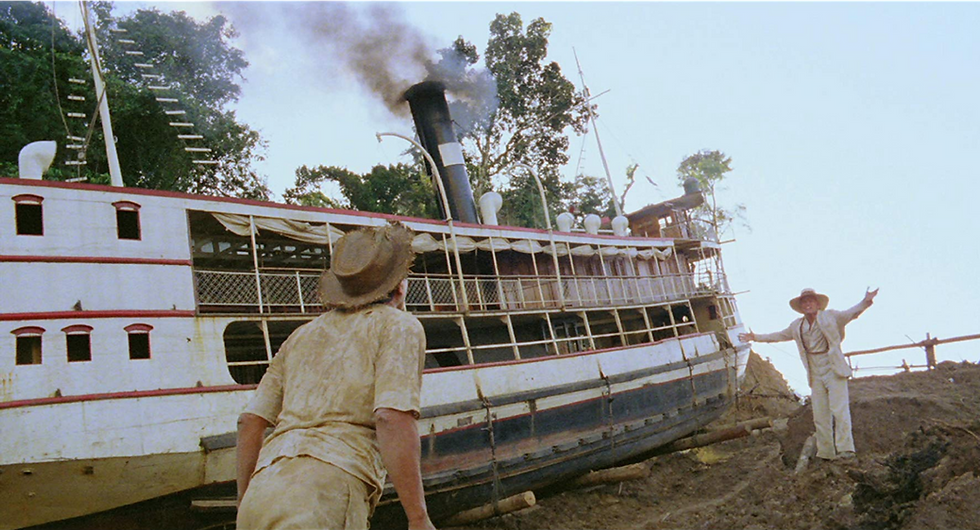
And this was all inspired by a Peruvian businessman who didn’t do one tenth of what the filmmakers he inspired achieved, and doesn’t this tell us something about art, about fiction? An artistic story tells a truth about the human experience that goes deeper than the surface-level subject matter of the main character. These stories must contain within themselves a higher reality, a higher truth. Stories like these that are inspired by true events must meet the same standard. When true events are inspiring but not cinematic enough, the filmmaker must use artistic license to heighten the reality of history to create a story that is worthy of being immortalized on film. As I said earlier, some filmmakers dramatize true events to make them slightly more entertaining for moviegoers, and then there’s Werner Herzog and Fitzcarraldo.
The film would not work as a realistic depiction of what Carlos Fitzcarrald did. Disassembling a ship, carrying the pieces over a mountain, and putting it back together in another river pales in comparison to the version of the story told in Werner Herzog’s film. Then again, maybe I’m wrong about that. Perhaps I am so biased by the true awe and beauty of Fitzcarraldo that now reality itself is unimpressive to me. After admiring Théodore Géricault’s painting The Raft of the Medusa in person in the Louvre, perhaps I would be unmoved by an actual shipwreck. That itself is an incredible achievement of the filmmakers—to tell a story so beautiful and so incredible that reality itself feels like a boring slough of mediocrity compared to what true genius can accomplish.
Fitzcarraldo, in surpassing by far the accomplishments of the man who inspired the film, creates a hyper-reality with its story—its events are so real that they don’t just tell an altered version of the story of Carlos Fitzcarrald, they fully eclipse his accomplishments and make him a historical footnote in the shadow of this cinematic giant.


Comments