Mulholland Drive

Not every film needs to be thoroughly understood on the first viewing. In fact, I often find that films that are more skillfully crafted reward repeat viewers with small details and clues that go unnoticed or overlooked during the first interaction with the story. Then there are films like Mulholland Drive that evade understanding even after a dozen viewings, yet still tell the audience that there’s something there, deep beneath the surface of the screen. While some may consider this to be cheap filmmaking, the equivalent of throwing spaghetti at the wall and telling the audience to figure out what it means, David Lynch’s 2001 film is different because there’s a serious, almost dire story behind the symbolism and nonlinear storyline. More than just a well-crafted film, I consider Mulholland Drive to be Lynch’s masterpiece.
Audiences often wonder what exactly Mulholland Drive is about. As the credits roll, we find ourselves knowing that it was about something disturbing, about the dark and unseen side of Hollywood and show business, though we can’t quite place our finger on what. The metaphorical and enigmatic nature of David Lynch’s direction leaves the film lingering in our minds long after the house lights have been lit again, and Lynch himself was stalwart in refusing to answer questions about the film or provide any clarity. He was a true artist through and through until the day he died.
Through the twisted timeline of the film and the dreamlike quality of its narrative, there are still a few storytelling elements that we can recognize—Betty, the Hollywood newcomer who dreams of making it big in the city of dreams; Adam, the hapless director who is somehow not in control of his own film; the pimp and assassin who takes cash in the diner near where the bum lives; the shady men in hidden, windowless rooms of the studio’s corporate headquarters, making decrees about films they’ll never see with just enough vague instructions to guarantee plausible deniability. These pieces come together to tell us something: Mulholland Drive is about a few artists who are struggling against unseen forces in the darkest city in the world to make names for themselves, to survive as artists in Hollywood. So why include the bizarre timeline? Why confuse the audience with what appear to be dream sequences?
In storytelling, a character’s dream is a direct window not only to their desires, but to their fears, to their psyche, to their entire subconscious. They provide the storyteller with an opportunity to create scenes dripping with metaphor and symbolism that would otherwise be unbelievable. David Lynch realized that the story of Mulholland Drive wouldn’t work if the real characters were introduced and then we were shown Diane’s dream (in which she’s named Betty). So he decided to invert the order, creating first the fantastical world of Diane’s dream, in which her Hollywood ambitions quickly become a reality, and then waking the audience up to the harsh world of her reality: a scorned actress pining for the woman who used her and discarded her as she, Diane, flounders in the shadow of show business, forgotten and overlooked as a supporting character in her own life’s story.
By introducing the fantasy first, Lynch suspends the disbelief of the audience as much as the story requires so that they can accept the crash back to reality. Because they’re already familiar with the bizarre, disorienting world of Diane’s dream, they look for the sources of reality that inspired the symbolism and metaphor of the world they’ve already accepted, which pulls them into the story even further just as it gets more confusing and illogical.
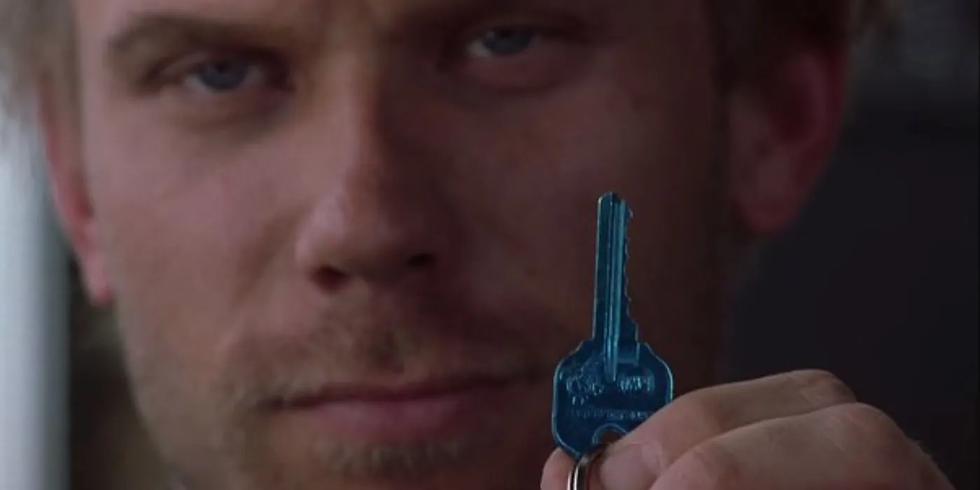
Mulholland Drive, for all its vagueness and indecipherable metaphors, warns its audience of two things: moral compromise and being fooled by an illusion. Though the exact source of Diane’s sin (her deal with the devil, if you will), by the nature of the film, we can deduce that it was most likely sexual in nature. In Hollywood, that may come in many forms but the gist is always the same: sexual favors in exchange for career opportunities. That’s the moral compromise, but what’s the illusion that fooled Diane? Perhaps the idea that the arrangement she initially agreed to would be there forever, that it would always be the reliable well she could draw from when she wanted to play the next role, or a part in the next film. That would explain why she wants to continue her relationship with Camilla, and her resentment when Camilla breaks things off. The Club Silencio sequence is pivotal. Not only does it tell Diane (in her dream in which she’s Betty) and the audience over and over again no hay banda (there is no band), that it is all an illusion, but it also presents to Betty the blue box that brings her back to reality. Perhaps this sequence would have been dismissed as an extra scene that could have been left in the cutting room had the ending of the film not returned to the club for the woman in the balcony to say one more time, “Silencio,” before cutting to the credits. Diane was not only persuaded to exchange her body for her career, something that she certainly swore she would never do when she won that jitterbug competition in Ontario, but she was swooned into the illusion of movie magic, of the fantasy of the city of dreams, only to be reminded that it never existed; that Hollywood was always a dark, cursed city crawling with the worst people imaginable who hide their depravity behind the glitz and glamor of show business. Not too different from Winkie’s, the diner with the bum who lives out back—tasty food, pretty waitresses in cute outfits, but more famous for what it hides than for what it contains.
Of course, David Lynch refused to provide any clarity to his film despite plenty of opportunities. This leaves us as the audience to find the exact meaning in a film that eludes logic and chronology, though the ambiguity of a film which clearly contains a message provides ample opportunities for discussion, to interpret and find meaning in the Rorschach test that is Mulholland Drive. Could we be mistaken about which parts are a dream and which parts are reality? Perhaps Betty arrived in Los Angeles, bright-eyed and bushy-tailed, as naive as the day is long, and really did have her first audition with the director, screenwriter, producers, and the star of the film. Maybe she saw a waitress at Winkie’s named Diane and then had a dream that her name was Diane, a disgruntled and vengeful actress who got dumped by her girlfriend just after they starred in a movie together. Perhaps her dream was a premonition of what could happen if she ever did sacrifice her morals for her career while in Hollywood. The uncomfortable party scene would be enough to convince anyone that fame is not worth the ostracization of sleeping your way to the top—yes, Diane gets to the party on top of the Hollywood hills, but she and Camilla came through the back of the yard instead of through the house like everyone else, and the older, more experienced Hollywood talent knows she doesn’t belong there. If the Diane part of the film is really Betty’s dream, then the dream ends with Diane taking her own life after being haunted by the memory of the older couple she met on the plane in real life.
Although the film is, or at least appears to be, about the exchange of sexual favors for one’s career in Hollywood, as I like to remind audiences, it’s in the specific that we find pieces of ourselves. Most of us aren’t, never have been, and never will be actors in Los Angeles, though almost all of us have been faced with the opportunity to compromise our morals to get something we want. Perhaps it was career-related, perhaps not, but Mulholland Drive still warns us of the hell we can wreak on our own lives by showing us a snapshot of Hollywood, the city of dreams poisoned by moral compromise, and like Coco’s heavy makeup, hides it behind a veneer of bright lights, giant sets, and flashy costumes. None of the waitresses in Winkie’s change the fact that there’s a bum living out back, caked in filth and unrecognizable to the world as anything other than an embodiment of sin. Do we have bums who live behind our homes? What keeps them there and how do we hide them from our guests?


Comments